
Best Canon lens for portraits: seven RF mirrorless choices
Start with the RF85mm F2 for planned individual portraits, the RF50mm F1.8 for tighter rooms, or an RF zoom when people and framing keep changing.
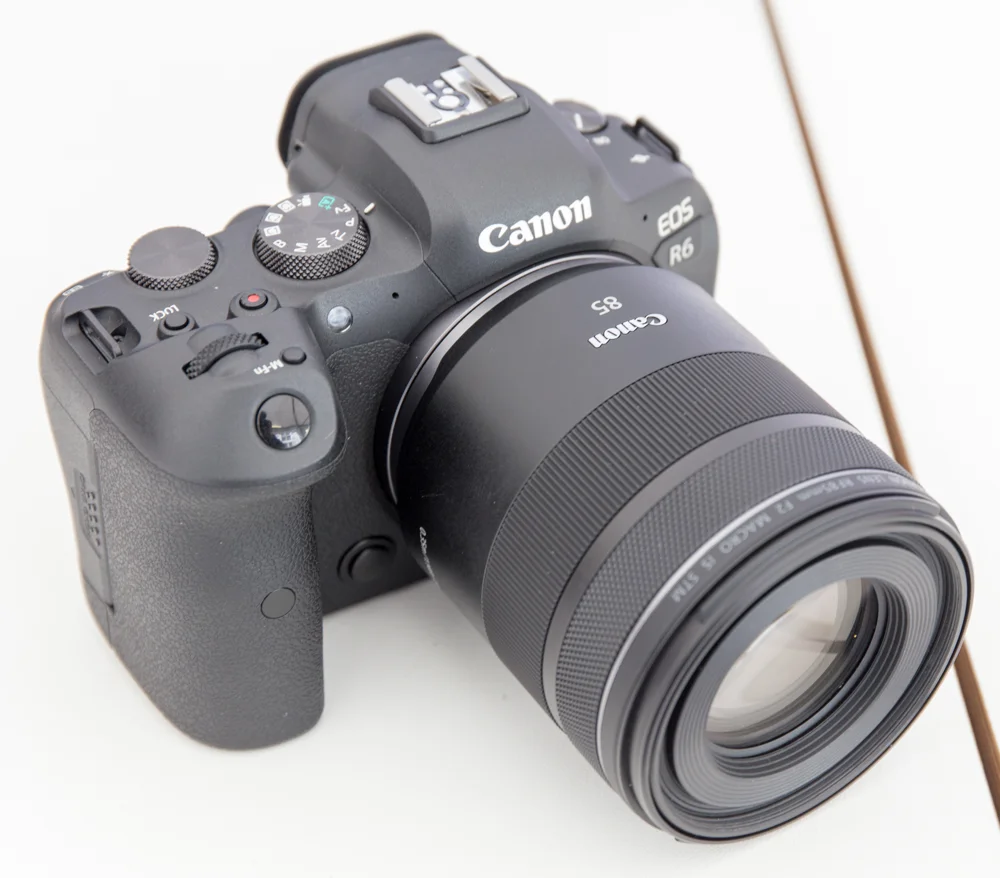

Choose for your room, then your aperture
The RF85mm F2 Macro IS STM is the starting point for planned individual portraits. Pick the RF50mm F1.8 STM if you work in a small room or want more of the surroundings in the picture. For groups and sessions where the framing keeps changing, start with the RF24-70mm F2.8 L IS USM.
All seven lenses fit Canon RF mirrorless cameras and cover full frame. They do not fit EF or EF-S DSLRs or EOS M cameras. An EF-to-RF adapter works in the other direction; it cannot put an RF lens on a DSLR. On an RF APS-C body, you see a narrower view, so check that you have enough room before choosing an 85mm or longer lens.
These recommendations draw on Canon specifications and independent reviews. We may earn a commission from qualifying purchases through the Amazon links. They open exact-model searches, so check the model, condition, seller, accessories, warranty and delivery before ordering.
Still choosing a body? The portrait camera guide considers that decision separately. For a system comparison, read the Nikon Z portrait lens guide. Its lenses are alternatives for Nikon owners, not fits for a Canon camera.
Compare the seven picks
A prime has one fixed focal length; a zoom lets you change the framing without changing lenses. The f-number describes the aperture, or lens opening. A smaller number means a wider opening that admits more light. These are all full-frame RF lenses, with tighter framing on APS-C.
| Lens | Best reason to choose it | Main compromise |
|---|---|---|
| Canon RF85mm F2 Macro IS STM | Individual portraits and half-life-size details | No weather sealing; not 1:1 macro |
| Canon RF85mm F1.2 L USM | Fast-aperture 85mm specialist | Heavy and no optical IS |
| Canon RF50mm F1.8 STM | Normal framing in a smaller room | Close-range quality caveat |
| Canon RF50mm F1.2 L USM | Fast normal prime | Large, heavy design |
| Canon RF135mm F1.8 L IS USM | Longer-distance individual portraits | Needs more room |
| Canon RF70-200mm F2.8 L IS USM | Changing headshot and event framing | Slower aperture than fast primes |
| Canon RF24-70mm F2.8 L IS USM | Groups and environmental portraits | Less telephoto range than 70-200mm |
RF85mm F2 Macro IS STM for a deliberate portrait session
Check Canon RF85mm F2 Macro IS STM on Amazon.com
Choose this for a session built around one person, especially if you also want details of hands or an accessory. Its 85mm focal length suits that focused brief, while Canon’s stated 0.5x magnification lets it record a subject at half its actual size on the sensor. That is useful close-up reach, but not life-size, or 1:1, macro.
The fixed view becomes awkward when you switch from a headshot to a group. You’ll need to move or change lenses. Photo Review also reports no weather sealing, so this is a better fit for a controlled session than a purchase made with outdoor protection in mind.
RF85mm F1.2 L USM when the wider aperture is the point
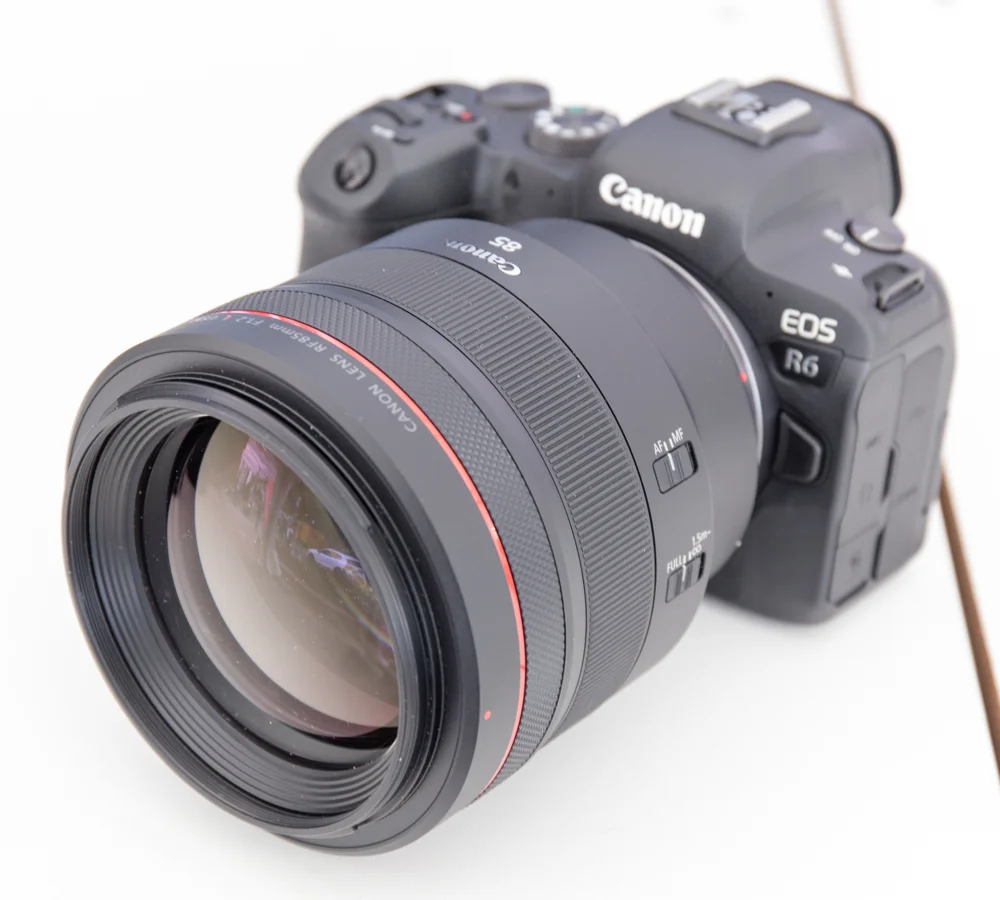

Check Canon RF85mm F1.2 L USM on Amazon.com
Buy the non-DS RF85mm F1.2 L USM for its f/1.2 opening. It admits more light than the RF85mm F2, but gives you the same focal length. It won’t help you fit a portrait into a smaller room.
The carrying cost is substantial. Canon lists 1,195g and no optical image stabilization, the lens feature that reduces camera shake. DPReview also describes its substantial size. If you don’t have a recurring reason to use f/1.2, start with the RF85mm F2 instead.
RF50mm F1.8 STM for normal framing before specialist gear
Product photo loads from Amazon when available.
Start here if an 85mm lens would put you against the back wall. On full frame, 50mm gives you more room in the picture, and its f/1.8 opening admits more light than the two f/2.8 zooms below.
It isn’t the close-detail alternative to the RF85mm F2. Canon lists 0.25x maximum magnification, and Cameralabs found weaker close-range quality than the RF35mm F1.8 and RF85mm F2. The review also reports no optical stabilization. Choose it for portraits in limited space, rather than for its close-up ability.
RF50mm F1.2 L USM for fast normal-prime work
Product photo loads from Amazon when available.
This is the 50mm choice if you need Canon’s documented f/1.2 aperture rather than f/1.8. It keeps the broader view of a 50mm lens instead of committing you to 85mm. Moving closer to match an 85mm composition will also change the perspective, so don’t expect identical pictures.
Cameralabs describes it as large and heavy. Accept that burden only if you’ll use the wider opening often; the L label alone isn’t a reason to buy it. Check that the listing says RF50mm, not the similarly named EF50mm F1.2 L.
RF135mm F1.8 L IS USM when you can stand farther back
Product photo loads from Amazon when available.
Choose the RF135mm for individual portraits in a location where you can stand farther back. Canon specifies a fixed 135mm focal length and f/1.8 aperture. To keep a person the same size in the frame, you’ll need more distance than with a 50mm or 85mm lens.
That makes it a poor default for small rooms or sessions that keep switching to groups, especially on APS-C. The Digital Picture provides an independent review, but the first buying question is practical: can you use 135mm in your usual locations?
RF70-200mm F2.8 L IS USM for changing compositions
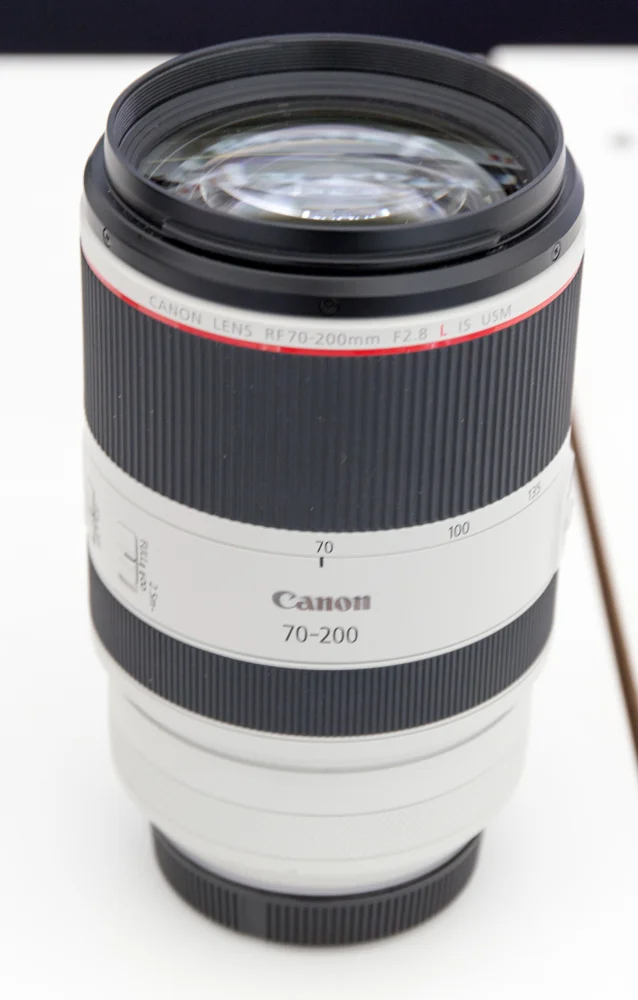

Check Canon RF70-200mm F2.8 L IS USM on Amazon.com
Choose the original, non-Z RF70-200mm when you need different tight compositions from roughly the same position. You can zoom between headshot framings rather than walking forward and back. Canon documents a constant f/2.8 maximum aperture, meaning the widest opening stays the same throughout the zoom range.
The tradeoff is less light through the lens than with the wider-aperture primes. At 200mm, you’ll also need room. Cameralabs reviewed this exact generation; this pick is not the Z version. If you rely on teleconverters or high-speed bursts, check Canon’s documentation for your specific lens-and-body combination.
RF24-70mm F2.8 L IS USM for people plus their surroundings
Product photo loads from Amazon when available.
This is the most useful starting point for groups and environmental portraits, pictures that include the person and their setting. Canon’s 24-70mm range gives you wider framing than the 70-200mm, with a constant f/2.8 maximum aperture.
You give up the longer zoom’s reach and the primes’ wider openings. Use the wide end to include surroundings, rather than moving very close to fill the frame with a face; that produces a different perspective from an 85mm portrait taken farther away. Digital Camera World has a hands-on review of this model.
Decide with the room before the aperture
Write down the pictures you must deliver. A solo headshot, a standing portrait and a family group are different requirements. If you already own a zoom, use it to check compositions at the candidate focal lengths in your actual room. Keep your camera position and framing notes. That is more useful than guessing a minimum working distance from a product name.
Then decide whether a fixed focal length is acceptable. A seated subject in a planned session gives you time to move. An event may not. Buy the zoom for that constraint, not on the assumption that every portrait needs extreme background blur. On APS-C, repeat the framing exercise on your own body rather than copying full-frame advice.
Finally, choose the aperture for the result. A wider maximum aperture is an available option, not an instruction to shoot every face or group wide open. Before replacing a lens, ask whether lighting, subject positioning or insufficient room is the actual problem.
Questions before checkout
Will these fit a Canon DSLR?
No native fit is claimed. These are RF lenses, not EF or EF-S lenses. This shortlist does not cover Canon DSLR owners.
Is an 85mm always better than a 50mm for portraits?
No. Start with the composition and available space. The 50mm options serve tighter rooms and broader context; an 85mm is a more restrictive choice on APS-C.
Does Macro mean life-size on the RF85mm F2?
No. Canon specifies 0.5x, or half life-size, not 1:1. Use that limit when planning detail pictures.
Which model mistakes should I avoid?
Check non-DS on the RF85mm F1.2, RF rather than EF on the RF50mm F1.2, and original non-Z on the RF70-200mm. Search results may include other versions.
The short recommendation
Choose the RF85mm F2 for planned individual portraits if you have room for 85mm framing. Choose the RF50mm F1.8 when space is the first constraint. For groups and changing environmental compositions, start with the RF24-70mm F2.8 instead. Buy a wider-aperture or longer prime only when it solves a problem you encounter regularly.
Sources and specifications
- RF85mm F2: Canon specifications, Photo Review.
- RF85mm F1.2, non-DS: Canon specifications, DPReview.
- RF50mm F1.8: Canon specifications, Cameralabs.
- RF50mm F1.2: Canon product page, Cameralabs.
- RF135mm F1.8: Canon specifications, The Digital Picture.
- Original RF70-200mm F2.8: Canon product record, Cameralabs.
- RF24-70mm F2.8: Canon specifications, Digital Camera World.
Related guides
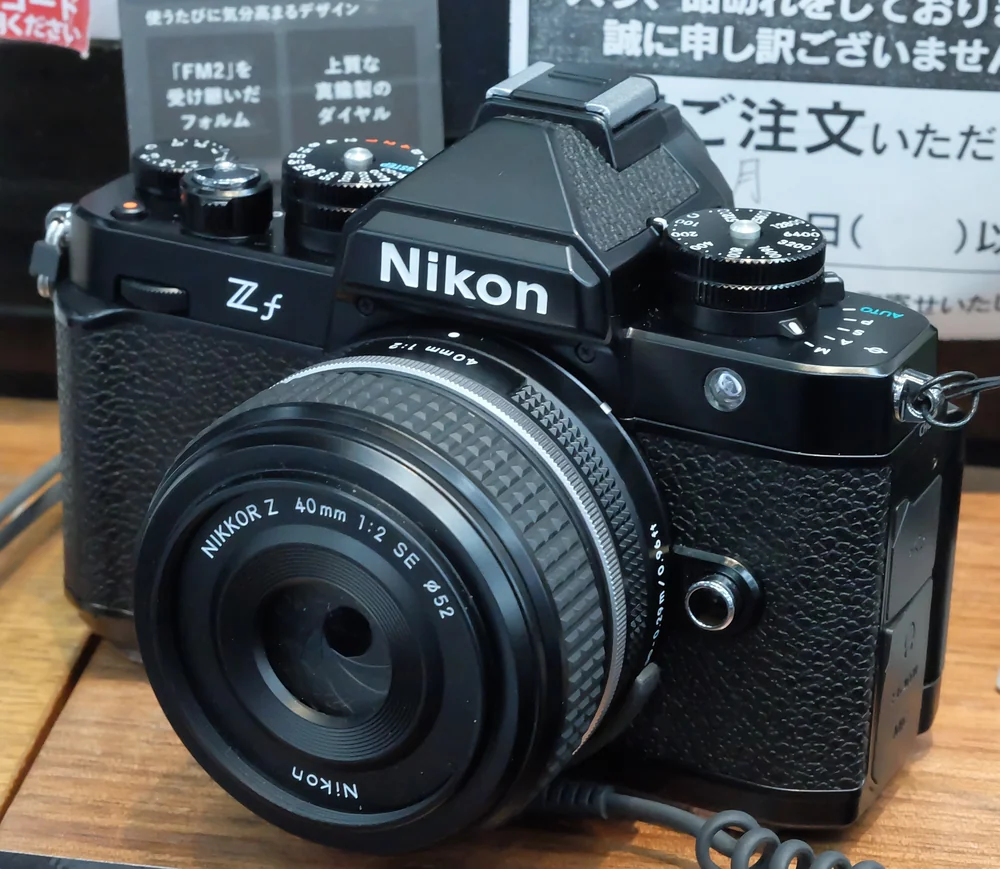
Best Nikon lens for portraits: seven Z-mount choices
Choose among seven Nikon Z portrait lenses by framing, aperture and room size, with FX and DX limits and sourced drawbacks for each exact model.
Best camera for beginners: seven choices for learning photography
Compare seven beginner camera candidates by viewfinder, stabilization, learning controls and lens-system commitments, with clear drawbacks and research sources.
Best camera for landscape photography: detail without the wrong kit
Seven research-based landscape camera picks, comparing single-shot detail, lens-system choices and field workflow without unsupported dynamic-range rankings.